Itsy-Bitsy Made Big
Our Insect Expert Trains Her Lens on the Tiny

“I’m obsessed with these little tiny ones. They look like little fairies,” says Lisa Gonzalez looking at a macroscopic image of a pixie-like wasp with outstretched wings and a dazzling metallic sheen. “This one is, I’m going to say, two millimeters in length and might literally look like a speck to the naked eye.”
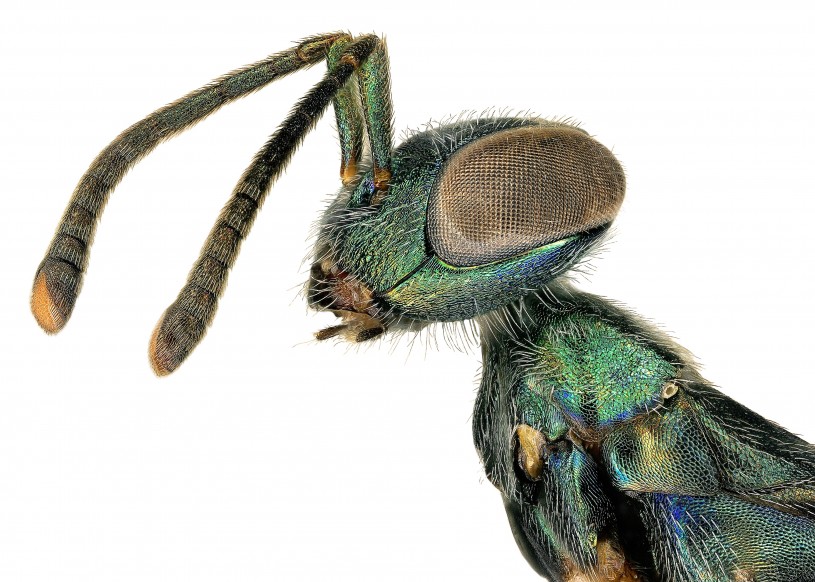
Before she became Program Manager of Invertebrates, Gonzalez was the museum's Entomology Assistant Collections Manager and oversaw the largest collection in Southern California, consisting of more than six million specimens of insects, spiders, and other terrestrial arthropods from around the world. The collection’s strength lies in its holdings of specimens of phorid flies, ants, scarab beetles, and moths from North and Central America. But she (along with then-Entomology Curator Dr. Brian Brown) plucked 14 to spotlight. Her portraits were taken using a Keyence Digital microscope with a built-in camera. The specimens were collected as part of BioSCAN (Biodiversity Science: City and Nature), a first-of-its-kind scientific investigation launched by NHM in 2012 to discover and explore the biodiversity of insects in L.A.
BUGS HAVE BENEFITS
These ultra-close-ups took many weeks to create. For each specimen, Gonzalez first cleaned off dust particles with a single-hair brush. Then she positioned the individual, sets the lighting, and adjusts the magnifications, which can zoom a max of 1,000 times. The crisp, focused images capture fine details of the animal's anatomy, such as a praying mantis turning its head or a flowerfly with delicate wings unfurled.
“I want to find something that looks almost as if it’s still in flight, or it’s looking at you and has some kind of expression to it, because I think someone having an emotional response is a good way to open up the conversation about what this insect does, where it lives, what its purpose is, and why we should value it. Insects provide essential ecological and environmental benefits. They are pollinators, (putting food on our tables), decomposers, and provide natural pest control as predators and parasites.
SUBURBAN SAFARI
Well before she even knew about the professional field of entomology, Gonzalez was obsessed with crawling, buzzing creatures. “As a small child, I would watch National Geographic and people going on a jungle safari, and then I’d go in the backyard and I would emulate that the best way I could. That meant looking through the grass and under leaf litter. And what was I mostly finding? Insects!”
Eventually, her childhood hobby became her profession, and NHM her second home. Gonzalez started as a volunteer in 2001 in the museum’s Insect Zoo. Later she received a B.S. in entomology from U.C. Riverside and joined the BioSCAN project in 2012. When she's not cataloguing specimens, or training a lens on the infinitesimal, Gonzalez loves to share her knowledge about these delicate invertebrates that we humans often overlook, dismiss as pests, or fear. “A lot of the aliens in science fiction are inspired by insects, but insects are really one of the dominant life forms on Earth,” she says, smiling. “So, it’s really us, the vertebrates, that are the weirdos."
Insect enthusiasts, join us for our annual festival—Bug Fair! Fly over to NHM on May 16 and 17 for our two-day fan-favorite festival celebrating our bug-eyed and multi-legged friends! Get tickets.
Interested in more insects? See more stunning, spiky, hairy, shiny photographs featured in this month's issue of National Geographic. Read the article with a National Geographic three month trial
